


Summary: Retailers face multifaceted challenges including increasing sales, fostering customer loyalty, and managing costs, exacerbated by factors like rising product costs and evolving consumer behavior. Optimizing store labor, traditionally viewed as an expense, emerges as a pivotal strategy, with a shift towards tailored workforce management models showcasing significant benefits including revenue growth, cost optimization, and enhanced customer experiences. By integrating real-time data and predictive analytics, retailers can align their systems with the customer journey, thus ensuring operational efficiency and long-term success.
Retailers face ongoing pressure to increase sales, gain customer loyalty, boost profitability, and trim working capital—particularly inventory. These challenges are compounded by rising product costs, competitive labor markets, expanding product lines, and a multitude of fulfillment options such as BOPIS (Buy Online, Pick Up In Store), in-store purchases, and traditional online orders with home delivery.
Enhancing the customer experience throughout their shopping journeys is paramount for achieving coveted loyalty and subsequent sales growth. From greeting the customers to offering additional services, store employees hold the key to making customer shopping experience enjoyable. The right staffing levels, coupled with training and motivation, not only boost customer satisfaction but also increase the likelihood of repeat sales. Retailers have traditionally viewed store labor as a cost, managing it by allocating a budget proportional to last year's store sales. This budget is then used to organize full-time and part-time employees into shifts that broadly align with customer traffic throughout the day, week, or month. Although some performance-based incentives exist, such as commissions for higher-end retailers or bonuses tied to achieving specific customer feedback thresholds, most retailers fail to fully harness the potential of store employees as key contributors to growth. After shifting this mindset business leaders would have to operating model, including revised business KPIs, training systems, and incentives at both corporate and store levels.
Explore VSOptima's Optimizing Workforce Use Cases
Most retailers fail to fully harness the potential of store employees as key contributors to growth.
Technology to rescue – new breed of AI and simulation solutions can help optimize employee engagement, dynamically adjusting capacity, schedule, flow metrics, skills, etc. to the store economics and customer traffic that is beyond classical workforce management solutions which are focused on employee journey from Hire to Retire and everything in between except actual business value in-store operations. To fully capitalize on these technological capabilities, a broader integration of HCM, WFM, Finance, POS, Analytics, and other systems would be essential.
Current capabilities gaps
- Siloed: The current technological landscape in retail encompasses workforce management systems, financial applications, and various operational tools such as merchandise, Inventory Management, Point of Sale (POS) systems, etc. Despite their potential, these systems suffer from a siloed and fragmented focus, narrowing on its own metrics without accounting for how they interplay to affect overall business performance. This lack of coordination leads to a reactive, rather than proactive, stance towards market dynamics, undermining the agility.
- Not real-time: Another issue across these platforms is their inability to inform decisions given the real-time or near to real-time data. This limitation hampers swift decision-making and adaptability in a market that demands immediate responses to fluctuations, marketing campaigns, and consumer behavior changes. Additionally, the predictive analytics capabilities within these systems are often limited, skewing towards long-term financial forecasting rather than offering the nuanced, operational agility needed for operations short-term adjustments. This deficiency in forecasting and real-time analytics restricts the ability to dynamically adjust store capacity and schedules in response to external factors that is the key for a store's performance.
- Not predictive: Moving forward requires a fundamental shift in approach: integrating workforce management, store operations, and financial planning around the customer journey. This holistic strategy aims to leverage real-time data and advanced predictive analytics to inform decisions across all facets of the business. By aligning these systems with the customer experience, retailers can ensure that their decisions not only enhance operational efficiency and financial performance but also boost customer satisfaction and loyalty.
How to do it differently?
To redefine workforce management in retail, we must acknowledge the interconnected nature of the customer journey and employee engagement, noting that this integration is specific to the store. What type of support is necessary to facilitate transactions and cultivate long-lasting relationships between customers and brands? This integration hinges on aligning behaviors, incentives, and ensuring that systems work in concert to optimize both customer satisfaction and store performance.
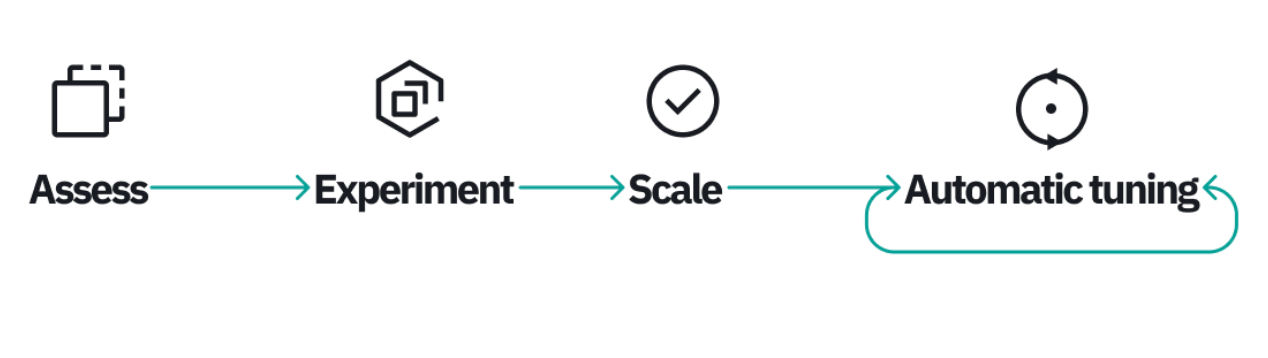
- Assessment and benchmarking: Start by analyzing the customer journey, understand how the employees' workflows fit into this, review the historical data of customer transactions, traffic, staffing etc. to understand nuances of store workforce management model, including staffing levels, schedule, incentives model across stores etc, affects the revenue and performance. Form hypothesis on the causality and potential impact from store workforce management to store performance.
- Experiment: Implement experiment for instance staffing adjustments in select test stores to validate the hypothesis that staffing levels significantly affect store performance and revenue to calibrate the impact.
- Scale: Roll out the validated strategy across all stores, tailoring store workforce management to the unique demand and performance potential of each location.
- Automatic tunig: Since the business is dynamic, decisions made once, will, with the time, lose their impact, unless adjustment is to the new market conditions is made.
What are the benefits?

The main advantage of this approach is seeing labor not just as an expense, but as a crucial tool for generating profits. By adopting a more nuanced workforce management strategies that take into account the varying impact of sales associates on revenue across different stores, retailers can achieve:
- Increased Revenue: Tailoring staffing levels to the unique characteristics of each store leads to a more engaged and effective workforce, directly impacting revenue positively.
- Optimized Labor Costs: Instead of a one-size-fits-all approach, allocating labor based on the specific needs and revenue potential of each store ensures that labor costs are invested where they can generate the highest return.
- Higher employee engagement: Revealed direct performance factors can be incorporated into incentives model, the better aligned staffing and scheduling can reduce burnout of employees matching demand and supply, and tailored employee journey all together drives employee engagement and reduce the risks of attrition.
- Enhanced Customer Experience: A tailored workforce management model ensures your store employees meet customers when they need the most to advise, recommend, and explain, improving overall satisfaction and loyalty, which drives repeat business and sales.
The implementation in 168 stores over a 6-month period produced a 4.5% revenue increase and a nearly $7.4 million annual profit increase.
The methodology, as validated by empirical studies Fisher, Gallino, and Netessine, not only substantiates these benefits but also quantifies the impact, showcasing a significant revenue increase and a notable profit uplift in the stores where it was implemented. The implementation in 168 stores over a 6-month period produced a 4.5% revenue increase and a nearly $7.4 million annual profit increase.
Where to start?
For retailers looking to harness this solution, the pathway begins with proof of value that takes a couple of weeks.
- Measure impact: Start with analyzing your stores to estimate the potential impact of workforce management model adjustment including staffing levels and schedule. This involves collecting and analyzing historical data on staffing, schedule, incentives, store performance, and traffic.
- Build Model: Develop a pilot model to guide decision-making regarding potential changes in staffing levels, schedule, and other factors. This model should be capable of simulating various scenarios and predicting their impact on revenue.
Plan for hypothesis verification and further operationalization, scaling, and continuous optimization. This approach, grounded in rigorous, field-tested research, offers a new operational framework that any retailer can implement to transform their labor management practices into a powerful engine for revenue growth and profitability.


Pavel Azaletskiy

Denis Grishin

Editor Victoria Karalionak